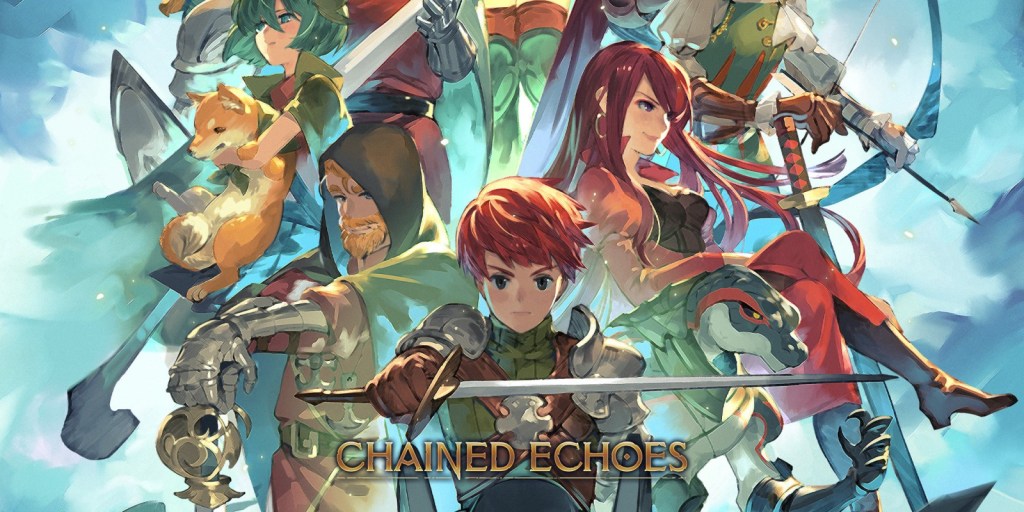
Playing Chained Echoes is like going to see a band you idolised in your youth. You go in wanting, and expecting, to see them play the hits – all the songs that made you fall in love with them all those years ago; and they do. However in between the songs you’ve heard a thousand times is their new stuff, and not only is it good but it melds with the older songs perfectly, creating something beautiful that is simultaneously exciting and comforting, fresh yet familiar.
Chained Echoes is a JRPG in the 16-bit style from German developer Matthias Linda and it ticks a lot of the boxes of the genre. There is turn-based combat, a kooky cast of characters that each take to their roles as warriors, healers and mages, and a main story arc that sees you go from a plucky ragtag group of misfits to slayers of God. But to reduce Chained Echoes to a homage or to accuse it of simply playing the hits would be a disservice to what is a genuine step forward for the genre that sets the bar ludicrously high for future endeavours.

There have been several attempts to breathe new life into a genre that has largely fallen by the way side in recent times. Octopath Traveller comes to my mind; with it’s eight intersecting storylines which the player can tackle in any order their heart desires. For me, what developers Square Enix failed to realise was that this ‘DIY’ form of storytelling is almost completely counterintuitive to a genre that relies so heavily on the relationships between it’s characters. When the player can tackle quests and recruit party members in any order they want it becomes incredibly difficult to be able to programme any meaningful interactions between party members. All developer control over pacing also goes out of the window.
And it’s where Octopath Traveller stumbles that Chained Echoes soars. The lore and the story telling in this game are it’s strongest asset, I would read and revel in a book based in this universe. I do understand that to some players a lore-heavy game can sound incredibly intimidating but I would argue that it’s not the magnitude of the lore that is a hurdle but the way that lore is conveyed. And instead of drowning you in a flood of information, it is drip fed to you through subtle interactions with the world, like a trickle from a faulty tap, and you lap up every single drop.
The game’s strength also comes from it’s cast of loveable heroes. Their personal journey’s and their growth play as big a part in the player’s investment as any other story telling devices. Particularly in the cases of Glenn and Lenne where (without going into too many spoilers) you as the player are invited to join them on their journey of self discovery. The cast is varied yet each of them contributes much to the party, sure some are more useful than others when it comes to combat but name me a JRPG where that isn’t the case. Each of them has their own personality and motives which are expertly interwoven into the main plot and the various side quests.
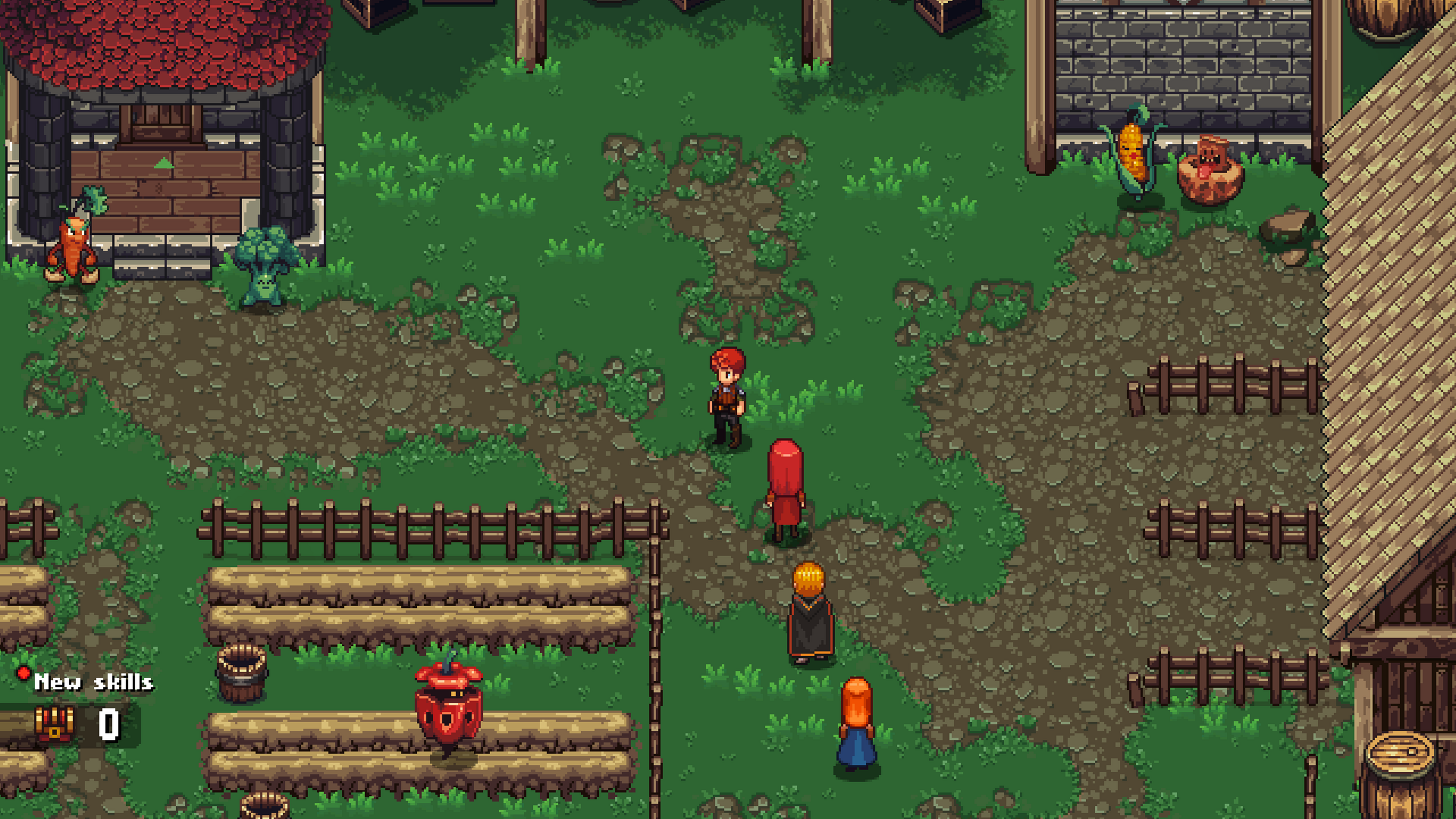
The side quests are another high point as there are only a handful but each one enriches the experience of the player either by providing extra context to the ongoings in the main plot or by driving character growth. There’s no pace-breaking tedious fetch quests to be found in this game and the experience is all the better for it. And it’s in these side quests that Chained Echoes did the rarest thing a video game can do – it made me laugh out loud. The game is beautifully self aware and it’s attempts at humour largely hit, unlike many of its predecessors which are more than capable of inducing a full body cringe.
But don’t be fooled, this is no laugh a minute experience. The game has a dark underbelly. I confess to being shocked at times by just how dark the game was willing to go, but far from being a cheap shock factor the dark underpinnings juxtapose beautifully with the twee pixel art style and upbeat music of the Dancing City of Farnsport or Rohlan Fields. Valandis, is after all a continent that has seen nothing but war for quite some time, it is only natural that in such an environment the darker nature of people rises to the surface.
So what makes Chained Echoes innovative? Well two things; one is the overdrive system which you are immediately introduced to and is integral to all combat for the rest of the game. Whilst on foot (more on this later) your chances of winning a battle are greatly influenced by your mastery of the overdrive bar which consists of three sections: yellow, green and red. Actions taken by a character move the marker on the bar either to the right and towards the red section or to the left and towards the yellow section. All combat begins in the yellow section where all of the players stats are completely normal, to get the most out of your party in combat you’ll want to push the marker to the right and into the green section which makes up the majority of the middle of the bar. In this green section characters use skills at half the cost of TP, deal more damage and receive less. However if you push it too far to the right and into the red zone your TP cost and damage dealt are reset to normal and you receive a good deal more damage than is normal. Most actions that the player takes push the bar to the right and moving the marker back towards the left is largely done by using a specific type of skill which is chosen at random by the game and changes every 4 turns. which means each combat becomes a delicate balancing act between using the skills most conducive to the current situation, whether that be healing or going on the attack whilst trying to keep the bar from slipping into the red by moving the marker back towards the left. This means at times the skill you want to use for the current battle state is not always the one that is best to use as pushing the bar into the red can be catastrophic.
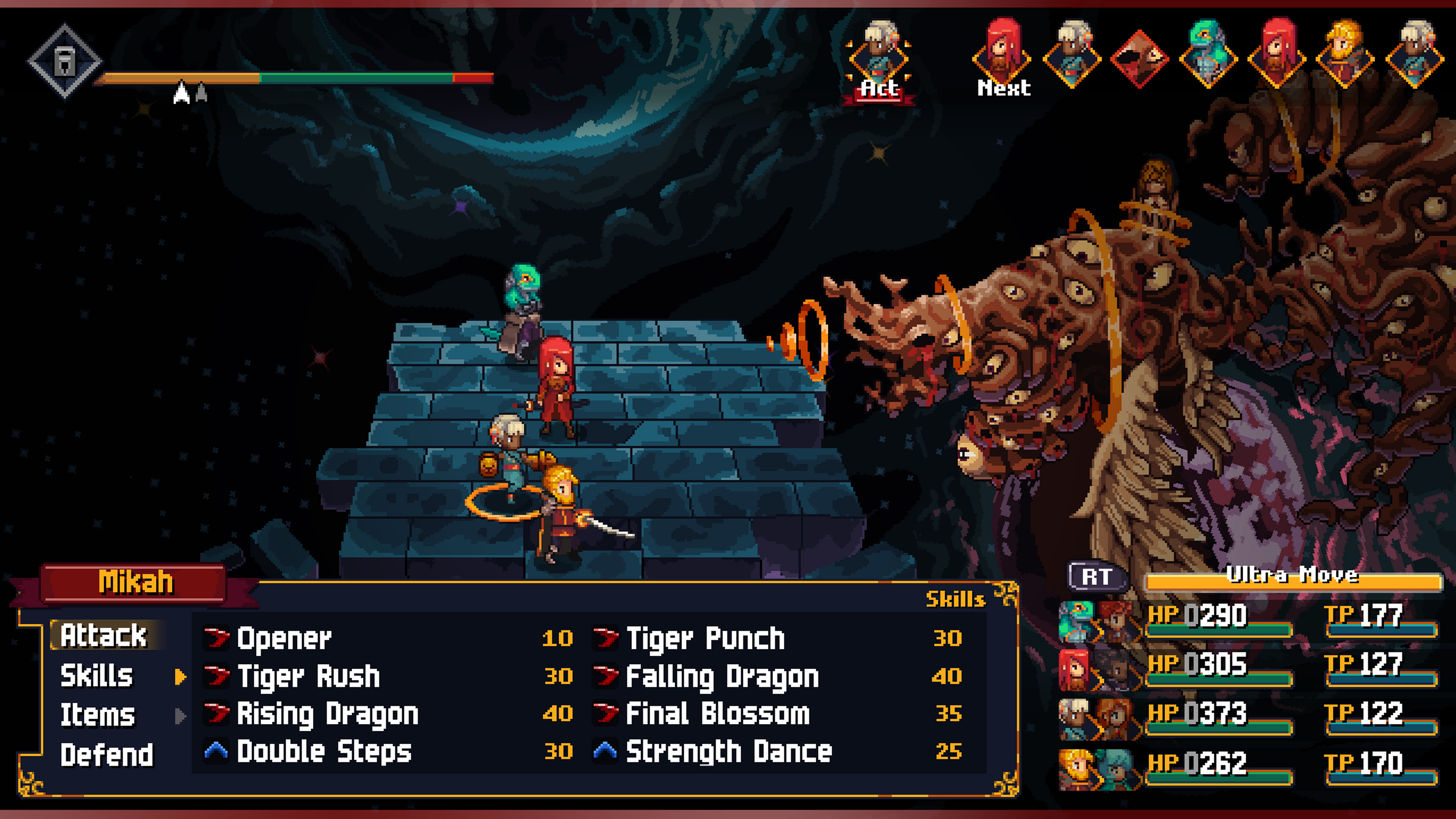
The overdrive system is pivotal to keeping combat fresh throughout the game. You can’t simply settle into the same pattern of, buff/debuff-attack-heal as at some point you will be required to break that pattern to keep your overdrive bar in check. This mechanism dampens the players ability to find the best skill and spam it until they win, which is too often the path to victory in many other JRPGs.
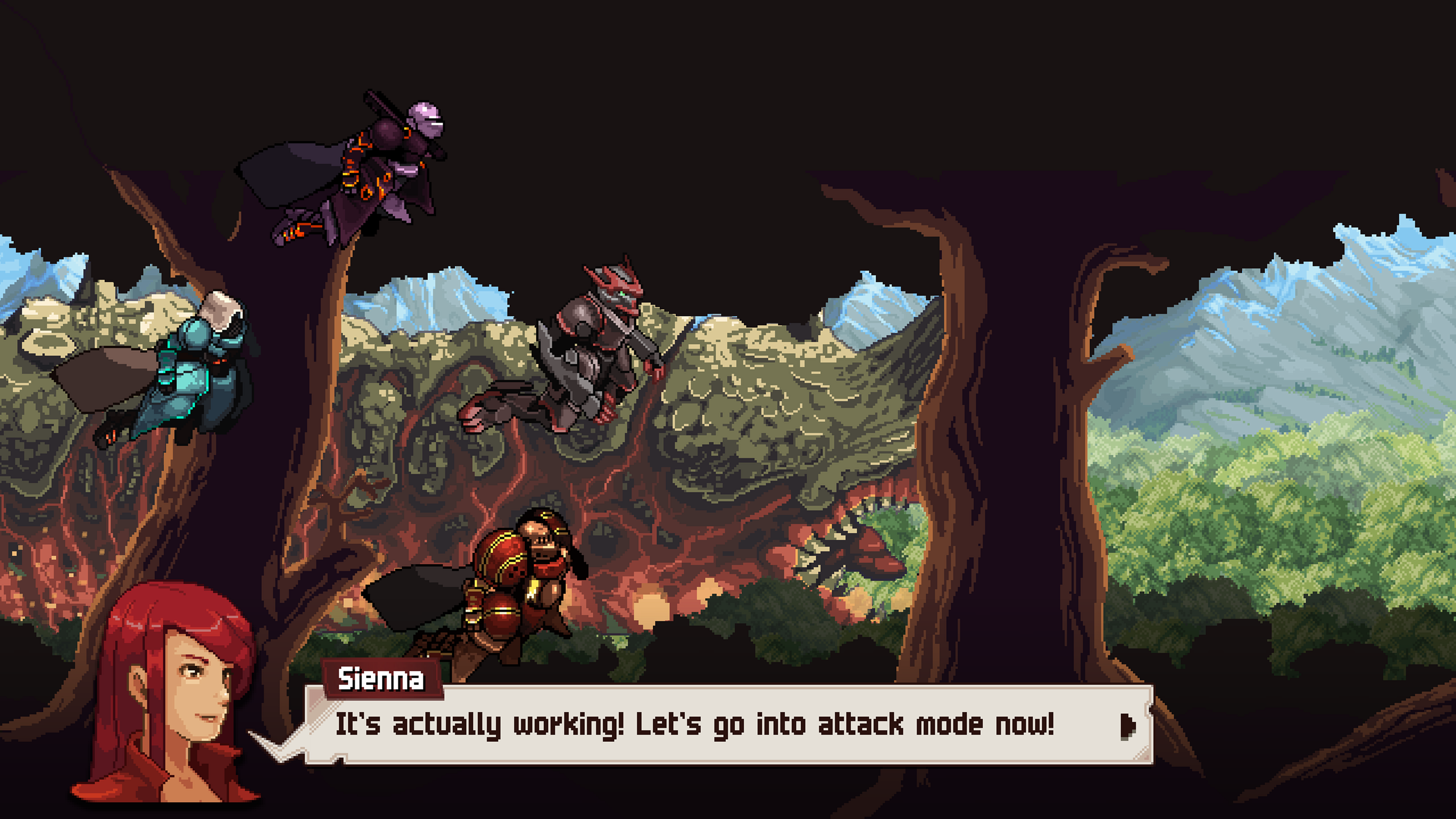
However the overdrive system is overshadowed in it’s ability to keep the game fresh by [slight spoilers, skip to the next paragraph if you wish to avoid] the introduction of power armours in the second act. Power armours are mechanised suits of armour which can be piloted by a few of the playable characters. Their combat abilities far outstrip anything the party is capable of on foot and they allow the player to hover and fly, meaning previously inaccessible areas of the world become traversable and a whole new raft of possibilities are unlocked. They also slightly change the way that combat and the overdrive system works although I won’t go into detail about that here. The important thing is that power armours add a whole new layer to the game previously unseen in the genre. The rest of the game becomes a balancing act of levelling up your party both on foot and in their power armours, which are done seperately.
The ‘levelling up’ system is also fairly unique and is where I foresee the most divisive potential for life long JRPG fans. There is very little room for grinding here, which I understand many enthusiasts of the genre will be disappointed about; grinding has become as synonymous with JRPGs as turn-based combat or gravity defying hairstyles. But for me personally, I welcomed the shift towards a levelling system based largely on story progression and exploration. There are ways to improve your combat proficiency outside of these but your major jumps forward in battle prowess will be achieved by killing bosses and exploring new areas that are only unlocked through progressing the story. Sacrificing grinding at the altar of pacing is for me a worthwhile trade and one that works particularly well in a game that’s biggest strength is it’s writing
By this point I’m sure I sound like a pre-teen gushing over their favourite popstar, and perhaps that’s a fair assessment. But Chained Echoes does have it’s faults. The crystal system of augmenting your weapons is unnecessarily complicated and I managed to complete the game without really ever paying much mind to it. Upgrading said weapons is also fairly redundant as by the time you’ve gathered the prerequisite materials you will often have found a stronger iteration. And the pause menu is lacking some sort of codex where you can flick back through past tutorials and bits of lore. However the reason I’m simply breezing through these drawbacks is because they do little if anything to dampen the player’s enjoyment of the game.
All in all Chained Echoes is a triumph of innovation and story-telling. Matthias Linda has produced a masterpiece that comfortably takes a seat both at the top table in it’s genre and in my heart.
(Chained Echoes is available on PC, Nintendo Switch, Playstation and Xbox and features on Xbox Games Pass)
 8-Bits and Bobs
Leave a comment